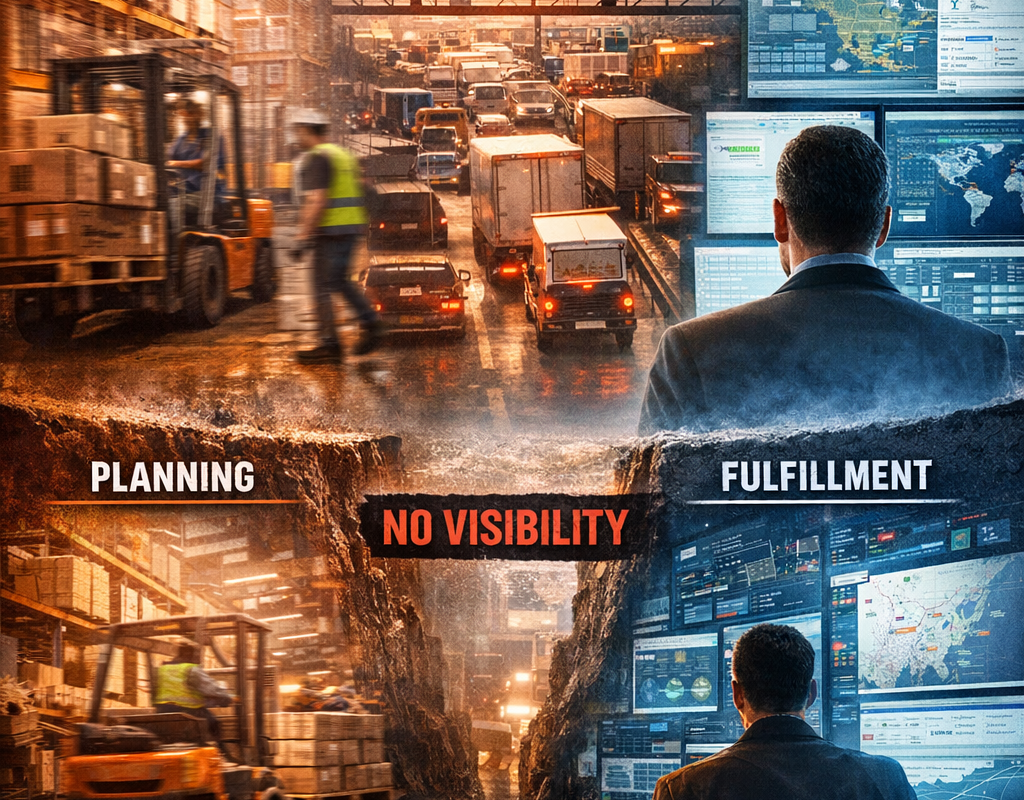
The supply chain industry has never been short on ambition. Billions of dollars have flowed into AI-driven sourcing, advanced planning platforms, and forecasting engines capable of simulating thousands of scenarios before a single decision gets made. According to The Hackett Group, leading procurement organizations now invest roughly 15% of their operating budgets in technology alone. AI is optimizing sourcing, automating negotiations, tightening compliance. Demand forecasting, inventory optimization, scenario planning – all of it has gotten smarter, faster, and more sophisticated.
And yet, many supply chains are still failing at the one thing that actually matters: execution. The thing that brings cash through the door.
The Illusion of Control
Most organizations genuinely believe they have their supply chain under control. It’s worth asking whether that belief holds up.
A FourKites survey found that 48% of supply chain leaders admit their digital maturity is below par, and 43% say they don’t have a single source of truth across their supply chain data. Think about what that means in practice. Million-dollar planning decisions are being made on top of fragmented data, delayed signals, and execution visibility that’s often unreliable at best. That’s not transformation. That’s a comfortable illusion.
Execution Is Still Broken
Walk into most mid-market operations and the pattern is familiar. WMS, ERP, and TMS systems that don’t fully talk to each other. Spreadsheets quietly holding the whole thing together. Decisions made hours — sometimes days — after the moment they needed to happen.
And here’s the frustrating part: even companies that invest in tier-1 fulfillment platforms don’t escape this. Because the problem isn’t really about which systems you have. It’s about what happens between them. McKinsey estimates that inefficiencies in mid- and last-mile logistics alone account for $65–$95 billion in annual waste in the U.S. That’s just one slice of a much larger problem.
It’s Not a Technology Gap. It’s a Decision Gap.
Most companies have digitized their processes. Very few have digitized their decision-making. Planning systems generate signals. Execution systems generate data. But there’s no unified layer connecting the two in real time, at the moment decisions actually need to be made.
The result? Forecasts that don’t account for warehouse constraints. Inventory decisions that ignore operational bottlenecks. Delays that only get flagged after the customer has already felt them. The data exists. The systems exist. But the connective tissue between planning and execution is still missing for most organizations.
The Missing Layer: S&OE
This is where the real gap sits — right in the middle, between the world of planning and the world of execution. This is the domain of S&OE: daily decisions, constant trade-offs, and the relentless rebalancing of demand, supply, and capacity happening hour by hour. It’s unglamorous work, but it’s where operations actually live.
And today, most organizations are running S&OE on static dashboards, lagging reports, and a lot of human intuition (Is that not a fact?).
The Next Battleground: Fulfillment Intelligence
The next wave of competitive advantage isn’t going to come from better planning tools alone. It’s going to come from real-time, predictive execution, from knowing what’s about to break before it does, understanding the downstream impact, and having a clear recommendation for what to do next.
A new category is beginning to emerge around this idea: fulfillment visibility and intelligence platform. Solutions like VisiQ are designed to sit between systems & pulling together WMS, TMS, ERP, automation, and other operational data into a single real-time execution layer. Not just to surface what’s happening, but to answer the harder questions:
What’s at risk? What’s the impact? What should we do right now? And when that intelligence connects to tier-1 execution systems like Infios and planning platforms like TrueGradient, it stops being siloed. It flows across the operation – from warehouse floor decisions back into planning and procurement, closing the loop the industry has been missing.
Mid-Market Companies Have a Real Window Here
Large enterprises are weighed down by their own complexity. They move slowly, and change is expensive. Mid-market companies don’t have that problem and that’s actually an advantage. There’s a genuine opportunity to leapfrog, not by ripping out existing systems or launching multi-year transformations, but by connecting what’s already there faster, building visibility earlier, and embedding decision intelligence into daily operations before the data silos calcify.
The winners in this next phase won’t necessarily be the ones with the biggest budgets. They’ll be the ones who connect planning to execution, break down silos before they become permanent, and turn insight into action faster than everyone else.
A Final Thought
For years, supply chain transformation has been defined by optimization — squeezing more efficiency out of existing processes, building better models, running smarter forecasts. The next phase will be defined by something different: awareness and action in real time.
Because at the end of the day, supply chains aren’t judged by forecast accuracy or system sophistication. They’re judged by something much simpler — did you deliver, on time, in full, without surprises
Everything else, is just noise.